00 // Ready-made infrastructure for AI pipelines
The run succeeded.
The work didn’t.
They returned a value. Nothing raised, nothing retried, the exit code was 0 — and the answer was wrong. You find out from a customer, two weeks later, and the smallest thing you can re-run is the whole batch.
Papayya grades every item, keeps the input that produced it, and lets you re-drive the one that broke.
30 minutes. It runs in your cloud.
1,000 items
30 didn't work.
Nothing raised. Nothing retried.
The output was an empty object.
- output
- {} empty_response
- ran
- completed
- worked
- degraded
- cost
- $0.0025
sample data · ticket_8357 is in the table below
01 // Inspect the run
sample data · the interaction is the product's
Here are
the thirty.
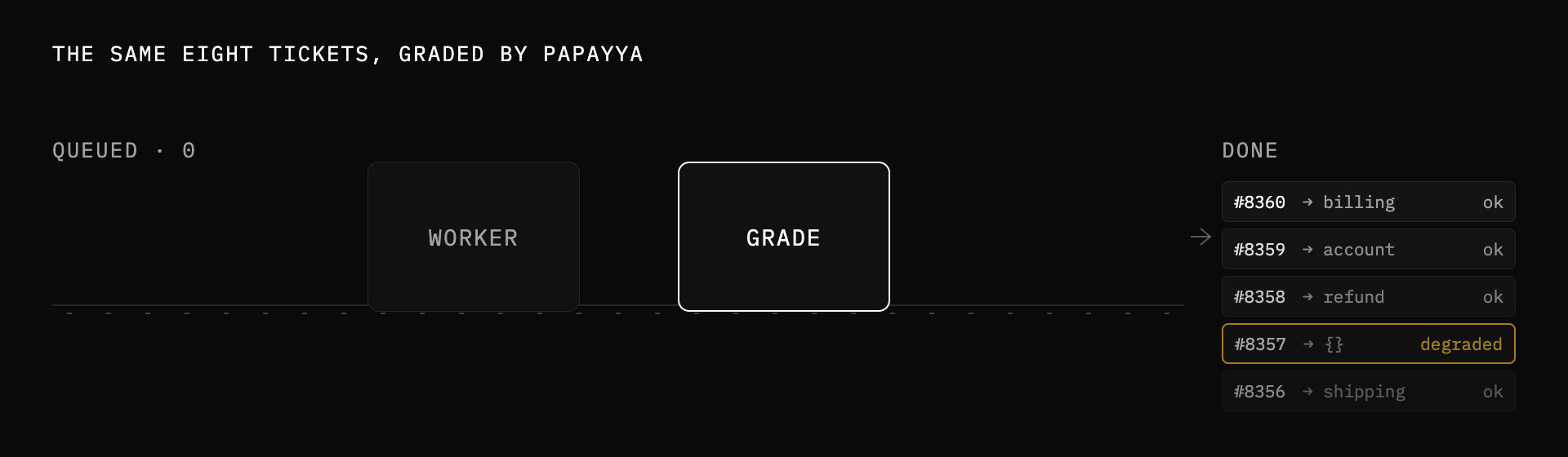
One run of tag_tickets. A thousand tickets, four tenants. The run exited 0. 30 of them did not work — and 21 of those finished cleanly and returned a wrong answer, so nothing raised and nothing was retried. Filter it. Re-drive one.
Items in the run
1,000
Worked
970
Need a person
30
Estimated run cost
$2.20
| Item | Tenant | Ran | Worked | Cost | Action |
|---|---|---|---|---|---|
| ticket_8168openai.rate_limit | acme | completed | degraded | $0.0021 | |
| ticket_8187openai.rate_limit | initech | completed | degraded | $0.0020 | |
| ticket_8209tool.invalid_input | umbrella | failed | failed | $0.0021 | |
| ticket_8268openai.rate_limit | initech | completed | degraded | $0.0025 | |
| ticket_8269tool.invalid_input | acme | failed | failed | $0.0020 | |
| ticket_8357empty_response | umbrella | completed | degraded | $0.0025 | |
| ticket_8368openai.rate_limit | initech | completed | degraded | $0.0019 | |
| ticket_8402provider.timeout | globex | failed | failed | $0.0025 | |
| ticket_8417empty_response | globex | completed | degraded | $0.0022 | |
| ticket_8431tool.invalid_input | initech | failed | failed | $0.0021 | |
| ticket_8451empty_response | globex | completed | degraded | $0.0021 | |
| ticket_8459tool.invalid_input | initech | failed | failed | $0.0019 | |
| ticket_8466schema_violation | globex | completed | degraded | $0.0019 | |
| ticket_8474schema_violation | acme | completed | degraded | $0.0019 | |
| ticket_8510openai.rate_limit | globex | completed | degraded | $0.0018 | |
| ticket_8576provider.timeout | globex | failed | failed | $0.0024 | |
| ticket_8587schema_violation | umbrella | completed | degraded | $0.0026 | |
| ticket_8621schema_violation | globex | completed | degraded | $0.0023 | |
| ticket_8694empty_response | initech | completed | degraded | $0.0024 | |
| ticket_8735schema_violation | globex | completed | degraded | $0.0019 | |
| ticket_8810tool.invalid_input | globex | failed | failed | $0.0019 | |
| ticket_8860openai.rate_limit | initech | completed | degraded | $0.0025 | |
| ticket_8938provider.timeout | globex | failed | failed | $0.0021 | |
| ticket_8942openai.rate_limit | acme | completed | degraded | $0.0024 | |
| ticket_8977empty_response | acme | completed | degraded | $0.0022 | |
| ticket_8991schema_violation | globex | completed | degraded | $0.0020 | |
| ticket_9011schema_violation | umbrella | completed | degraded | $0.0023 | |
| ticket_9037empty_response | umbrella | completed | degraded | $0.0018 | |
| ticket_9051provider.timeout | initech | failed | failed | $0.0025 | |
| ticket_9056openai.rate_limit | initech | completed | degraded | $0.0026 |
02 // The infrastructure, already built
The scaffolding,
already built.
Queue, retries, per-item state, per-tenant cost — the scaffolding you were going to write around your pipeline anyway.
Developer resources- Queue
- Retries
- Per-item state
- Per-tenant cost
- 01Grade
Ran and worked, two facts.
Every item is graded as it finishes. Whether it ran and whether it worked are recorded separately, so a wrong answer that exited 0 lands in the work list.
- 02Keep
The input that produced it.
Every item keeps its own id, its input, its outcome and its cost, per tenant. You can name page 73, not just the document it came in.
- 03Re-drive
Only the one that broke.
Re-driving an item reuses the steps that already worked instead of recomputing them. Nothing downstream moves that did not need to.
- 04Run it
In your cloud.
A decorator on the function you already have, not a re-architecture. The whole stack runs in infrastructure you own.
03 // A real call · measured, not imagined
A 150-page report. Page 73 came back blank.
This is a real call, and the numbers are measured rather than imagined. What changes is not the speed — it is whether there is anything smaller than the document to ask about.
The pipeline they have
Re-run the document
page 73 is degraded · there is no smaller unit to re-run
On Papayya
Re-drive page 73
page 73 is degraded · it is an item with its own id
counts are measured · timing is not to scale
Executed to fix one page
1page
Steps reused
149
Recovery, this case
40sec
Cost, this case
$0.002
150 pages · 300 page executions to fix one · vs 1 executed, 149 reused
An agent is the same shape. Turn 18 fails. You pay for turn 18, not turns 1 through 17.
What that saves, measured04 // From the blog
The long
version.
All posts01 / Field notes
Your task queue did its job. The answer was still wrong.
A queue's contract is the exit code. A model call can return a well-formed wrong answer and exit 0. What a queue gives you, where it stops, and what we haven't built yet.
Read the post02 / Field notes
Your agent isn't slow because of the CPU
A twenty-turn agent spends almost all its time waiting, and no hardware changes that. What does: never running turn 1 again because turn 18 failed.
Read the post03 / Field notes
What it means to be fault tolerant in the AI age
Notion pulled every Anthropic model from its picker — not because the API was down, but because it was degraded, returning 200s that didn't work. That's the failure nothing in your stack was built to catch. Here's the layer that catches it.
Read the postStart with your workload
See it run on your own workload.
Thirty minutes, in your cloud, against a batch you already have.